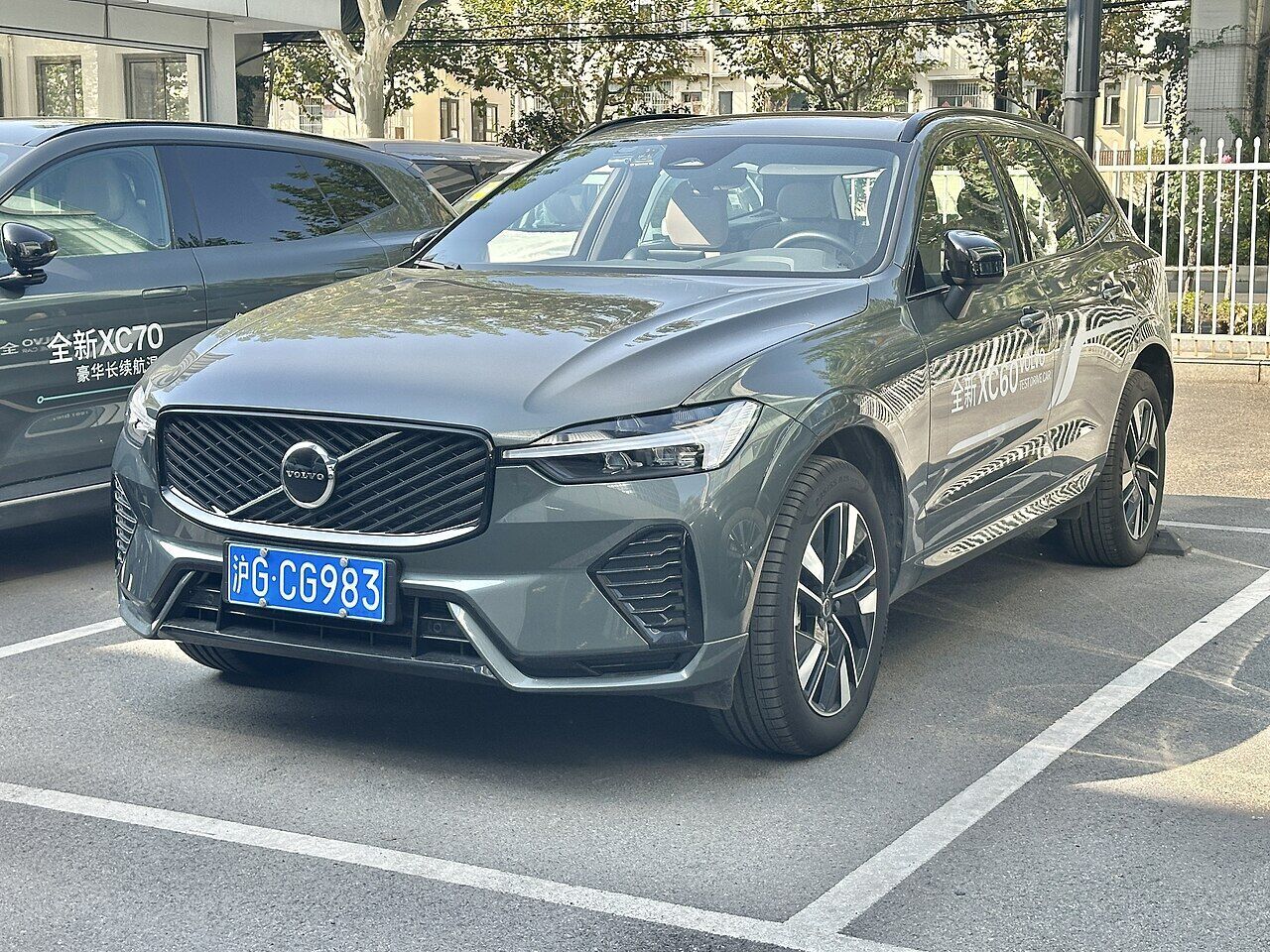
Volvo XC60 (2024) specs, price, ratings and reviews
Mid-size SUV on the SPA platform, on the market since 2017 and facelifted in 2024.
from € 67,995
Category scores
Specifications
- Generation
- II T6 Recharge plug-in (facelift 2024)
| Body style | SUV |
|---|---|
| Seats | 5 |
| Doors | 5 |
| Power (hp) | 350 |
| 0–100 km/h (seconds) | 5.7 |
| Top speed (km/h) | 180 |
| Length (mm) | 4,708 |
| Width, excl. mirrors (mm) | 1,902 |
| Height (mm) | 1,656 |
| Kerb weight (kg) | 2,150 |
| Battery capacity (kWh — larger = longer range) | 14.7 |
| Electric range (WLTP, km) | 78 |
| Consumption (WLTP, l per 100 km) | 1 |
| Towing — braked (with trailer brakes) (kg) | 2,250 |
| Boot (l) | 468 |
Fast charging at a public charger (10→80%)
| Charging situation | 10→80% (minutes) |
|---|---|
| At a 150 kW charger | ~ 7 |
| At a 50 kW charger | ~ 20 |
Charging at home uses AC power and is slower: a home wallbox typically delivers 7.4 to 11 kW. That is separate from the fast-charge times shown above.
More on this: fast charging in practice, public charging and charging passes.
Real-world consumption
- Owners report
- 2.4 l/100km
- WLTP (manufacturer figure)
- 1 l/100km
- Difference vs WLTP
- +140%
Price evolution
| reference date | starting price |
|---|---|
| 2024-01-01 | €65,995 |
| 2025-01-01 | €66,995 |
| 2026-05-18 | €67,995 |
Frequently asked
What does the Volvo XC60 cost roughly?
Indicative starting price € 67,995 (reference date 2026-05-18). Not an offer.
What does the Volvo XC60 consume?
1 l/100km WLTP (manufacturer figure). Real-world consumption differs; see the owner reviews below.
How much can the Volvo XC60 tow?
2250 kg braked (with trailer brakes) — the figure that applies when your trailer (such as a caravan) has its own brakes. Manufacturer figure; the exact, binding limit for a specific car is on its registration document.
How big is the battery in the Volvo XC60?
14.7 kWh usable capacity (manufacturer figure). Check the warranty terms of the specific car for capacity retention.
How much boot space does the Volvo XC60 have?
468 litres (manufacturer figure). See the spec sheet for the full dimensions.
Owner experiences
No owner has written in about this one yet. If you drive it, yours would be the first. Write the first owner review.
In depth
The T6 Recharge plug-in couples a 2.0 petrol engine to an electric motor and a 14.7 kWh battery; system power 350 hp and WLTP EV range 78 km (manufacturer figure). WLTP consumption 1.0 l/100km depends heavily on the charging ritual; owners report 5 to 8 l/100km once the battery stays empty (public forums, not measured by us).
About the Volvo XC60 T6 Recharge (2024)
Independent spec and rating reference. No offers, no sales.
The second XC60 generation has been on the SPA platform since 2017 and was facelifted in 2024 with new lights, a Google-based infotainment update and a revised colour palette. The T6 Recharge plug-in version pairs a 2.0 petrol four-cylinder with an electric motor on the rear axle and a 14.7 kWh battery (gross). System power 350 hp, WLTP EV range 78 km, WLTP combined consumption 1.0 l/100km (manufacturer figure, only relevant with full battery daily).
In practice
The WLTP figure of 1.0 l/100km is a calculation that assumes daily charging. Owners who really charge daily report 1.5 to 3.0 l/100km in mixed traffic with mostly short trips; owners who do not charge land at 5 to 8 l/100km (owner forums, n approx 25, not measured by us). The boot measures 468 l with the battery in the floor, braked towing weight is 2,250 kg. The indicative list price rose from about 65,995 euro (reference date early 2024) to 67,995 euro now, a starting price, not an offer and not a forecast.
Points to note
The WLTP figure of 1.0 l/100km only applies with disciplined charging; without charging the consumption is comparable to a normal petrol SUV. Charging goes via AC up to 6.4 kW; DC fast charging is not on this model (recurring owner point). The added weight of the battery is noticeable in steering feel compared with the mild-hybrid B5; consider this on the test drive.
Related models
No tax or financial advice. Every figure shows its source and reference date. Always compare with an independent adviser and the official source. Source: OEM datasheets + RDW + ADAC (see methodology); rating and price reference dates are listed per figure.