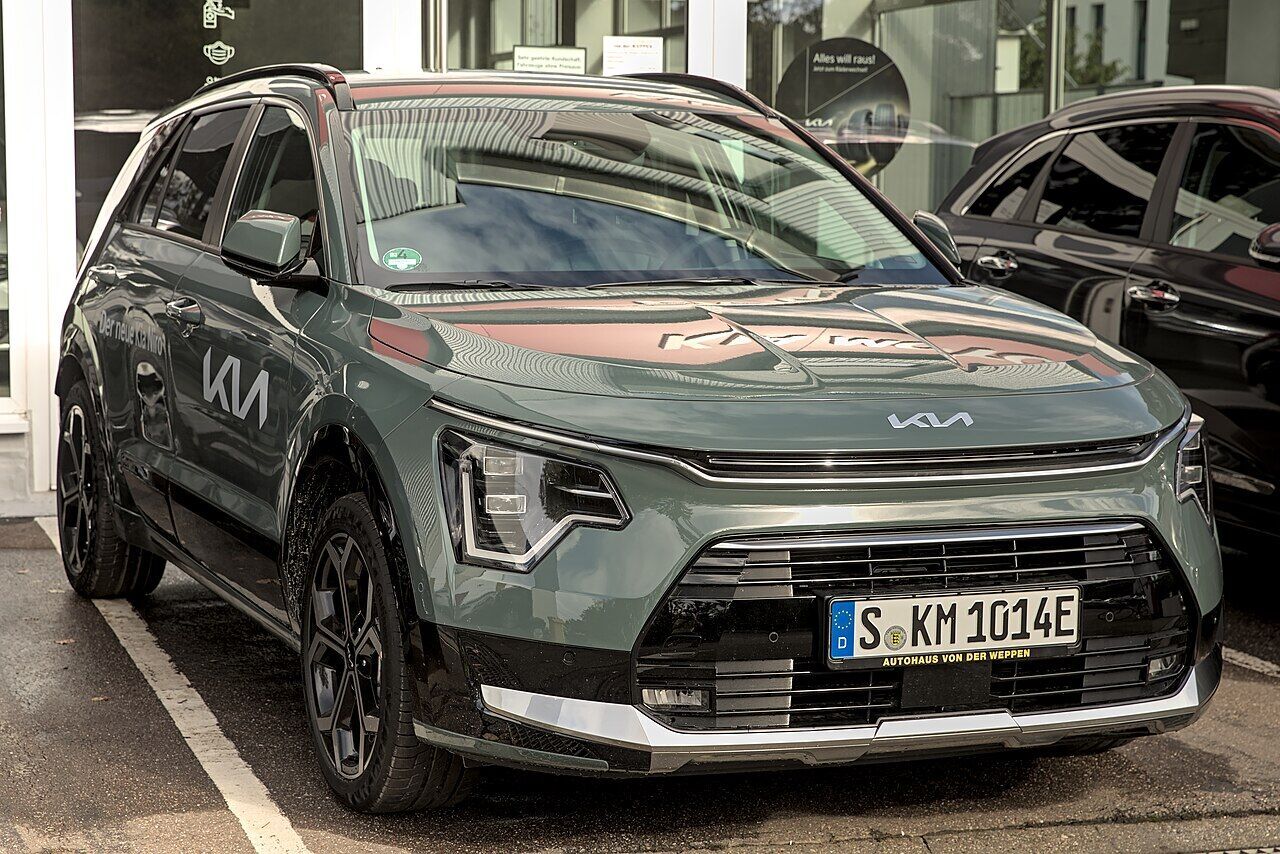
Kia Niro (2024) specs, price, ratings and reviews
Plug-in hybrid crossover.
from € 39,995
Category scores
Specifications
- Generation
- PHEV (SG2, 2023+)
| Body style | Crossover |
|---|---|
| Seats | 5 |
| Doors | 5 |
| Power (hp) | 183 |
| 0–100 km/h (seconds) | 9.6 |
| Top speed (km/h) | 168 |
| Length (mm) | 4,420 |
| Width, excl. mirrors (mm) | 1,825 |
| Height (mm) | 1,545 |
| Kerb weight (kg) | 1,594 |
| Battery capacity (kWh — larger = longer range) | 11.1 |
| Electric range (WLTP, km) | 65 |
| Consumption (WLTP, l per 100 km) | 1 |
| Towing — braked (with trailer brakes) (kg) | 1,300 |
| Boot (l) | 348 |
Fast charging at a public charger (10→80%)
| Charging situation | 10→80% (minutes) |
|---|---|
| At a 150 kW charger | ~ 5 |
| At a 50 kW charger | ~ 15 |
Charging at home uses AC power and is slower: a home wallbox typically delivers 7.4 to 11 kW. That is separate from the fast-charge times shown above.
More on this: fast charging in practice, public charging and charging passes.
Real-world consumption
- Owners report
- 5.5 l/100km
- WLTP (manufacturer figure)
- 1 l/100km
- Difference vs WLTP
- +450%
Price evolution
| reference date | starting price |
|---|---|
| 2024-01-01 | €38,495 |
| 2025-01-01 | €39,295 |
| 2026-05-18 | €39,995 |
Frequently asked
What does the Kia Niro cost roughly?
Indicative starting price € 39,995 (reference date 2026-05-18). Not an offer.
What does the Kia Niro consume?
1 l/100km WLTP (manufacturer figure). Real-world consumption differs; see the owner reviews below.
How much can the Kia Niro tow?
1300 kg braked (with trailer brakes) — the figure that applies when your trailer (such as a caravan) has its own brakes. Manufacturer figure; the exact, binding limit for a specific car is on its registration document.
How big is the battery in the Kia Niro?
11.1 kWh usable capacity (manufacturer figure). Check the warranty terms of the specific car for capacity retention.
How much boot space does the Kia Niro have?
348 litres (manufacturer figure). See the spec sheet for the full dimensions.
What the press has reported
What others wrote, condensed. Every claim stays attributed and links back to the original review, so you can read the full verdict where it was written.
What owners report elsewhere about the Niro
This is a summary of public forums, not verified by us and not a first-party review. Recurring points: those who charge every day drive large portions electrically and keep fuel consumption low; those who rarely charge sit, according to user reports, around 5-6 l/100km in hybrid mode. The real-world electric range is reported at around 45-55 km, lower than the 65 km WLTP, especially in winter. Plus points in the posts: space, warranty and quiet EV mode; criticism concerns the modest charging speed of the AC charger and the loss of boot space due to the battery pack. See the sources for the original, full posts.
sources: MotorTalk: Kia Niro PHEV Forum · Spritmonitor: Kia Niro PHEV verbruiksdata
Owner experiences
Only works if you charge consistently · 4/5
Anonymous owner · 2026-03-05 · owner experience
I have a charging point at home and charge every evening. My daily trips of 30-40 km I do almost entirely on electric power, with a real-world electric range of around 50 km, and closer to 42 in January. On the occasions when I couldn't charge and made long trips, I was around 5.5 l/100km, which is just a hybrid carrying battery weight. So anyone who doesn't plug it in drives it expensively. Space and finish are fine, although the boot is smaller than I had expected because of the battery.
*Submitted via the review form and moderated (only spelling/readability adjusted, content and score unchanged).*
Show 2 more experiences
With daily charging almost no petrol, empty battery is disappointing · 4/5
Anonymous owner · 2026-02-20 · owner experience
My commute is around 40 km per day, and I charge at home every evening. As a result I drive almost entirely electric on weekdays; the electric range is fairly accurate, in spring I get close to 60 km, in winter more like 45. I refill the tank at most once every two months. The real picture emerges on holiday: with an empty battery it drives like an ordinary hybrid and I sit around 5.8 l/100km on the motorway, loaded with luggage even toward 6.3. That's no disaster but far from the WLTP figure. The transition between electric and petrol is usually smooth, sometimes the switchover jolts slightly with a cold engine. The boot, at 348 l, is on the small side for a crossover, the battery takes up space.
*Submitted via the review form and moderated (only spelling/readability adjusted, content and rating unchanged).*
Without the ability to charge: then you're buying an expensive hybrid · 2/5
Anonymous owner · 2026-04-12 · owner experience
Important to be honest: I don't have a charging point at home and I can't charge at work either. In my situation that means I almost always drive with an (almost) empty battery. In that case fuel consumption is around 5.5-6 l/100km combined, and I'm lugging around the battery weight without getting anything in return for it. The WLTP figure of around 1 l/100km is something I've never come close to seeing, simply because I can't charge. That was my own misjudgement, not a manufacturing fault, but it brings the score down. What is good: the car drives comfortably, the finish is neat and the controls with physical buttons work nicely. For someone who can charge every day this is probably a different story; in my usage the technology doesn't get a chance to show its worth.
*Submitted via the review form and moderated (only spelling/readability adjusted, content and score unchanged).*
In depth
Electric WLTP range 65 km; the WLTP figure of 1.0 l/100km applies only with a full battery and short trips. With an empty battery the car drives like a regular hybrid; then count on 5-6 l/100km (owner figure, not measured by us). Braked towing weight 1,300 kg.
About the Kia Niro PHEV (2024)
Independent spec and rating reference. No offers, no sales.
The WLTP figure of 1.0 l/100km is only achievable for those who charge often and drive short trips. Those who rarely fill the battery in fact drive a hybrid. The car shares the drivetrain with the Niro Hybrid, with a larger battery (11.1 kWh) and a charging connection. Kia's factory warranty (up to 7 years) weighs in the reliability score; see the source line.
In practice
With an empty battery owners report around 5.5 l/100km in hybrid mode (owner forums, n≈18, not measured by us), far above the WLTP reference value of 1.0. The actual average depends entirely on how often you charge (utility factor); the methodology is in the guide on PHEV consumption. The indicative list price rose from about 38,495 euro (reference date early 2024) to 39,995 euro now, a from-price, no offer and no forecast.
Points to note
Boot 348 l is modest because of the battery under the load floor. Electric driving at motorway speed shortens the 65 km WLTP range noticeably. Charging goes only on alternating current; fast charging is not possible. Calculate for yourself whether you use the electric range in practice before you put this variant above the regular hybrid.
Related models
No tax or financial advice. Every figure shows its source and reference date. Always compare with an independent adviser and the official source. Source: OEM datasheets + RDW + ADAC (see methodology); rating and price reference dates are listed per figure.