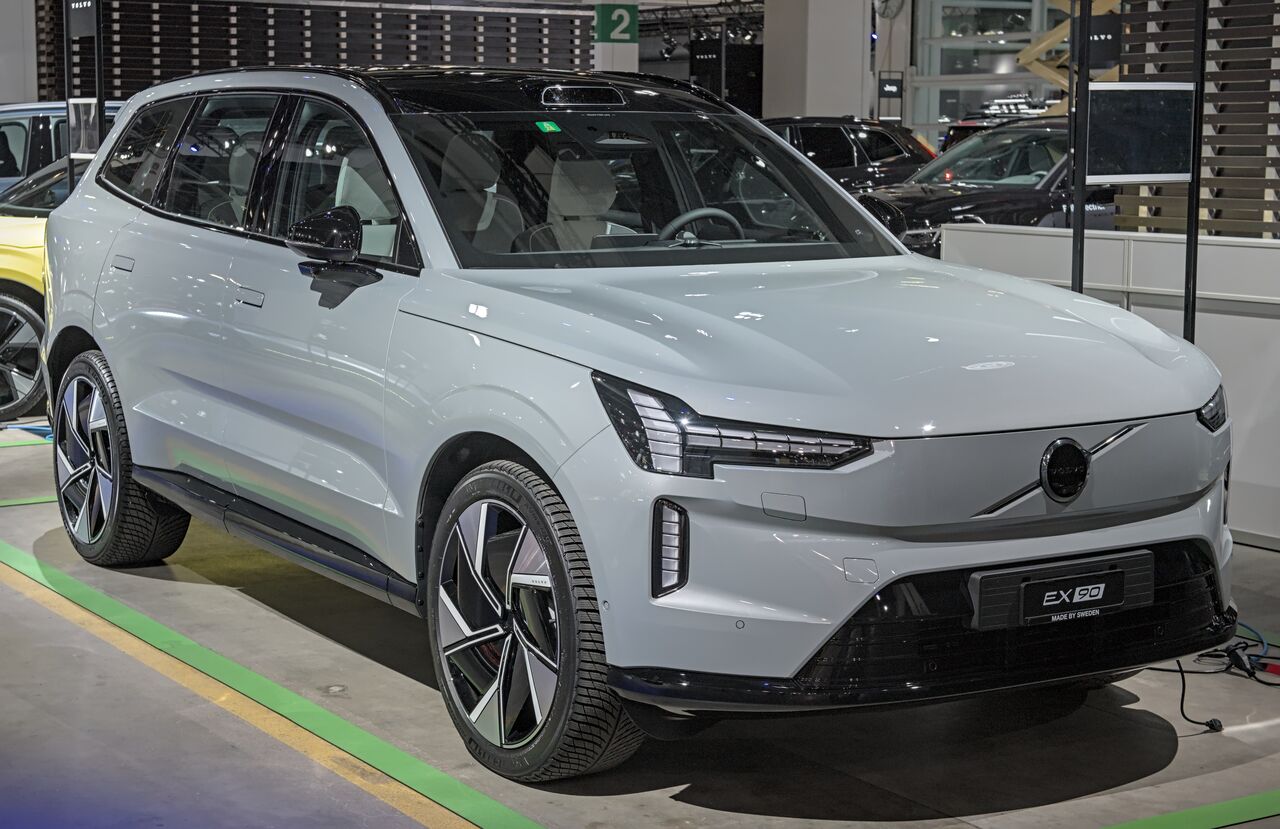
Volvo EX90 (2024) specs, price, ratings and reviews
Large electric 7-seat SUV on the new SPA2 platform (shared with the Polestar 3).
from € 105,995
Category scores
Specifications
- Generation
- Twin Motor (2024)
| Body style | SUV |
|---|---|
| Seats | 7 |
| Doors | 5 |
| Range (WLTP, km) | 614 |
| Battery capacity (kWh — larger = longer range) | 107 |
| Power (hp) | 408 |
| 0–100 km/h (seconds) | 5.9 |
| Top speed (km/h) | 180 |
| Length (mm) | 5,037 |
| Width, excl. mirrors (mm) | 1,964 |
| Height (mm) | 1,747 |
| Kerb weight (kg) | 2,779 |
| Fast charging, public charger (kW, peak) | 250 |
| Towing — braked (with trailer brakes) (kg) | 2,200 |
| Boot (l) | 310 |
| Consumption (WLTP, kWh per 100 km — lower is better) | 19.9 |
Fast charging at a public charger (10→80%)
| Charging situation | 10→80% (minutes) |
|---|---|
| At the car's own maximum charging rate (250 kW) | ~ 29 |
| At a 150 kW charger | ~ 48 |
| At a 50 kW charger | ~ 145 |
Charging at home uses AC power and is slower: a home wallbox typically delivers 7.4 to 11 kW. That is separate from the fast-charge times shown above.
More on this: fast charging in practice, public charging and charging passes.
Price evolution
| reference date | starting price |
|---|---|
| 2024-06-01 | €103,995 |
| 2025-01-01 | €104,995 |
| 2026-05-20 | €105,995 |
Frequently asked
What does the Volvo EX90 cost roughly?
Indicative starting price € 105,995 (reference date 2026-05-20). Not an offer.
What is the WLTP range of the Volvo EX90?
614 km WLTP (manufacturer figure). Owners typically report less in everyday driving, especially in cold weather. See the reviews below.
How much can the Volvo EX90 tow?
2200 kg braked (with trailer brakes) — the figure that applies when your trailer (such as a caravan) has its own brakes. Manufacturer figure; the exact, binding limit for a specific car is on its registration document.
How long does fast-charging the Volvo EX90 take (10→80%)?
Roughly 29 minutes on a 250 kW charger (10→80%, factory calculation, indicative). Actual time depends on battery temperature and the charging curve — the car's charging speed drops as the battery fills.
How big is the battery in the Volvo EX90?
107 kWh usable capacity (manufacturer figure). Check the warranty terms of the specific car for capacity retention.
What does the Volvo EX90 use in real-world driving?
The factory WLTP figure is 19.9 kWh/100 km. Owners typically report more in mixed use, with the usual winter penalty. See the owner experiences below.
How much boot space does the Volvo EX90 have?
310 litres (manufacturer figure). See the spec sheet for the full dimensions.
Owner experiences
No owner has written in about this one yet. If you drive it, yours would be the first. Write the first owner review.
In depth
Twin Motor with 408 hp and a 107 kWh pack (usable), WLTP range 614 km (manufacturer figure). DC charging up to 250 kW, braked towing 2,200 kg. Software was mentioned as a point to get used to at launch; updates arrive over the air (public owner reports, not measured by us).
About the Volvo EX90 Twin Motor (2024)
Independent spec and rating reference. No offers, no sales.
The EX90 is Volvo's first full size electric SUV and the first model on the SPA2 platform, shared with the Polestar 3. Production started in May 2024 in Charleston (US) for global markets. The Twin Motor variant has dual motors with system power of 408 hp, a 107 kWh battery (usable, 111 gross) and WLTP range of 614 km (manufacturer figure). DC charging peaks at 250 kW; braked towing is 2,200 kg. Standard configuration is seven seats across three rows.
In practice
WLTP consumption is around 19.9 kWh/100km (manufacturer figure). Early owners report real-world consumption in the low to mid 20s in mixed use, higher on motorway and in winter (owner forums, n small, not measured by us). Boot volume is about 310 l behind the third row, expanding significantly with rows folded; check the official configurator for exact figures per market. Kerb weight is around 2,800 kg, which is noticeable in chassis behaviour and tyre wear.
Points to note
The interior centres on a 14.5 inch portrait screen running on Google built in; almost all secondary controls run via this screen, with no physical climate buttons (recurring owner point). Software gave several bug reports at launch (driver assistance, charging behaviour, infotainment) that have been partly resolved through over the air updates. The car ships with LiDAR hardware for future advanced driver assistance functions; activation depends on market and software release. Take a test drive at the official dealer and pay attention to screen controls and rear visibility through the heavily raked tailgate.
Related models
No tax or financial advice. Every figure shows its source and reference date. Always compare with an independent adviser and the official source. Source: OEM datasheets + RDW + ADAC (see methodology); rating and price reference dates are listed per figure.