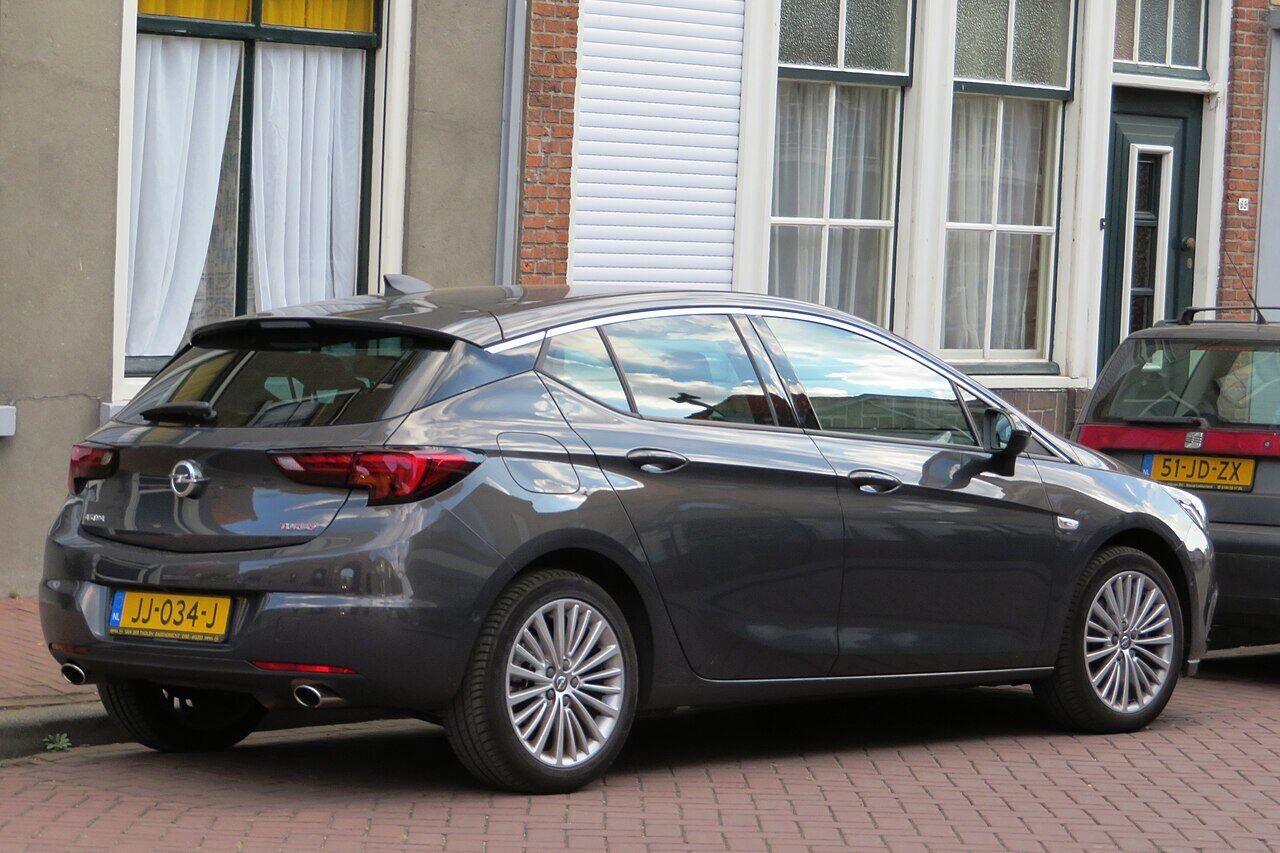
Opel Astra (2016) specs and history
Astra K with a factory-fitted 1.4 turbo installation (bi-fuel, 2015-2021).
Category scores
Specifications
- Generation
- K 1.4 LPG (2015-2021)
| Body style | Hatchback |
|---|---|
| Seats | 5 |
| Doors | 5 |
| Power (hp) | 145 |
| Length (mm) | 4,370 |
| Width, excl. mirrors (mm) | 1,809 |
| Height (mm) | 1,485 |
| LPG consumption (l per 100 km) | 7.6 |
| Petrol consumption (l per 100 km) | 5.8 |
| Towing — braked (with trailer brakes) (kg) | 1,400 |
| Boot (l) | 370 |
Real-world consumption
- Owners report
- 8.3 l/100km
Frequently asked
Is the Opel Astra still sold as a new car?
No. This model has not been sold as a new car for years (last model year 2021). We sell nothing and do not refer you to a dealer. This page shows the technical specs as a reference.
How much can the Opel Astra tow?
1400 kg braked (with trailer brakes) — the figure that applies when your trailer (such as a caravan) has its own brakes. Manufacturer figure; the exact, binding limit for a specific car is on its registration document.
How much boot space does the Opel Astra have?
370 litres (manufacturer figure). See the spec sheet for the full dimensions.
What the press has reported
What others wrote, condensed. Every claim stays attributed and links back to the original review, so you can read the full verdict where it was written.
What owners report elsewhere about the Astra
This is a summary of public forums about a discontinued model, not verified by us and not a first-party review. Recurring points: LPG consumption is reported at around 7.5-8.5 l/100km and petrol towards 6 l/100km (user-reported figures). The factory-fitted LPG system is experienced as more durable than separate aftermarket conversions. The most frequently mentioned point of attention is wear of the LPG vaporiser and valves at high mileage, with attention to regular maintenance. This summary is a historical spec reference, not buying advice. See the sources for the original, complete posts.
sources: MotorTalk: Opel Astra K Forum · Spritmonitor: Opel Astra K 1.4 LPG verbruiksdata
Owner experiences
Cheap miles, just check the vaporizer in time · 4/5
Anonymous owner · 2026-02-20 · owner experience
I drove this Astra K with factory-fitted LPG as a high-mileage car for a long time. On gas I was around 8 l/100km, on petrol closer to 6; thanks to the lower per-litre price of LPG the fuel costs were manageable. The installation worked flawlessly for years, but at higher mileage I noticed that the vaporizer needed attention, which was part of periodic maintenance. Otherwise a comfortable, spacious hatchback for long trips. I share this as a reference for those looking up the specs, not as purchase advice.
*Submitted via the review form and moderated (only spelling/readability adjusted, content and score unchanged).*
Show 2 more experiences
Drove it on bi-fuel for eight years, replaced the vaporiser on time · 3/5
Anonymous owner · 2026-01-18 · owner experience
Owned it for eight years, mostly long commutes on LPG, by now well over 180,000 km. The factory-fitted LPG system simply did its job for years, and that was the strong point: starting on petrol, then switching automatically to gas after warming up. My LPG consumption was around 8 l/100km combined, higher per 100 km than petrol but the gas price made up for it. I also had the well-known age-related issue: around 150,000 km the vaporiser started to play up, cold starting became more difficult, and at the inspection it turned out replacement was needed. After that service everything ran normally again. Otherwise a pleasant hatchback with a solid chassis; the infotainment of that generation is slow by today's standards. This is a long-term ownership experience and a historical reference, not a purchase recommendation.
*Submitted via the review form and moderated (only spelling/readability adjusted, content and score unchanged).*
Roomy enough as a family car, the gas system needed attention · 4/5
Anonymous owner · 2026-03-04 · owner experience
Used as a family car with two children, a mix of city and motorway driving, for years around 20,000 km per year. The 1.4 turbo with 145 hp had enough power to keep up easily, and even on gas I barely noticed any power loss. The 370 l boot was just about enough for our family holidays. A practical point over the years: the LPG system requires maintenance that a petrol car does not, an annual check of the hoses and eventually the vaporiser. A couple of times I had a filter replaced because the car ran unevenly on gas. On petrol it always ran flawlessly. I have not seen any rust on this particular example, the bodywork held up well. I describe this as the experience of a long-term owner and as a spec reference, not as buying advice.
*Submitted via the review form and moderated (only spelling/readability adjusted, content and score unchanged).*
Still driving this model? A long-term experience helps other visitors.
In depth
Reference model for spec lookup and switch orientation. LPG consumption per 100 km is higher than petrol (7.6 vs 5.8 l/100km, NEDC era indicative), the price per litre is lower. Known age-related point: wear of the LPG vaporiser at high mileage (owner reports, historical).
About the Opel Astra K 1.4 LPG (2015-2021)
This model is no longer available as a new car. It is in the database as a historical reference: for looking up specifications and as input for switch orientation from an older model. There is deliberately no new price and no buy button; we are not a marketplace and do not broker in second-hand purchases. The introduction price (2016) is solely historical context, not a current value.
In practice
The car switches between LPG and petrol itself and has a factory-fitted 1.4 turbo with an LPG installation. Per 100 km LPG consumes more than petrol (indicative 7.6 vs 5.8 l/100km, NEDC era, no WLTP measurement), but the price per litre of LPG is lower. In LPG mode owners report in mixed use around 8.3 l/100km (owner forums, historical, n≈15, not measured by us). Whether LPG works out net more advantageous depends on the daily prices and the annual mileage; you work that out yourself, we give no cost advice. The introduction price of 23,499 euro (2016) is solely historical context.
Points to note
At high mileages wear of the LPG vaporiser is a recurring point in aggregated owner reports (historical, not verified by us); periodic maintenance of the LPG installation is part of this type of drive. In case of a possible second-hand choice, ask for the maintenance history of the gas installation and the inspection date of the tank. We do not broker in second-hand purchases.
Related models
No tax or financial advice. Every figure shows its source and reference date. Always compare with an independent adviser and the official source. Source: OEM datasheets + RDW + ADAC (see methodology); rating and price reference dates are listed per figure.