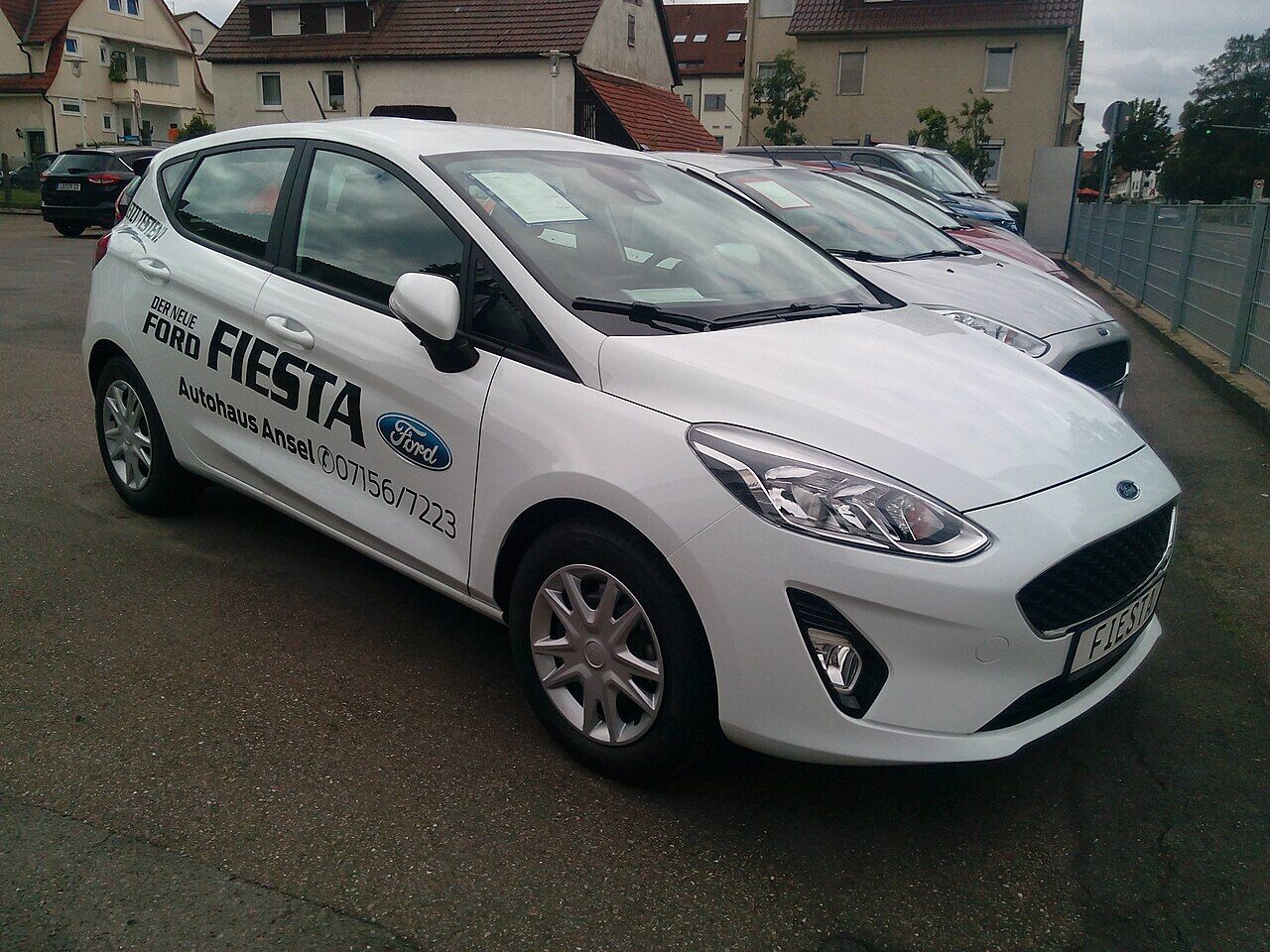
Ford Fiesta (2017) specs and history
Mk7 Fiesta (2017-2023, EU production ended 2023), 1.0 EcoBoost three-cylinder turbo petrol.
Category scores
Specifications
- Generation
- Mk7 1.0 EcoBoost (2017-2023)
| Body style | Hatchback |
|---|---|
| Seats | 5 |
| Doors | 5 |
| Power (hp) | 100 |
| 0–100 km/h (seconds) | 10.5 |
| Top speed (km/h) | 183 |
| Length (mm) | 4,040 |
| Width, excl. mirrors (mm) | 1,735 |
| Height (mm) | 1,476 |
| Kerb weight (kg) | 1,163 |
| Petrol consumption (l per 100 km) | 5.5 |
| Towing — braked (with trailer brakes) (kg) | 900 |
| Boot (l) | 292 |
Real-world consumption
- Owners report
- 6.2 l/100km
Frequently asked
Is the Ford Fiesta still sold as a new car?
No. This model has not been sold as a new car for years (last model year 2023). We sell nothing and do not refer you to a dealer. This page shows the technical specs as a reference.
How much can the Ford Fiesta tow?
900 kg braked (with trailer brakes) — the figure that applies when your trailer (such as a caravan) has its own brakes. Manufacturer figure; the exact, binding limit for a specific car is on its registration document.
How much boot space does the Ford Fiesta have?
292 litres (manufacturer figure). See the spec sheet for the full dimensions.
What the press has reported
What others wrote, condensed. Every claim stays attributed and links back to the original review, so you can read the full verdict where it was written.
What owners report elsewhere about the Fiesta
This is a summary of public forums about a model that is no longer in production, not verified by us and not a first-party review. Recurring points: real-world fuel consumption of the 1.0 EcoBoost around 5.8-6.5 l/100km (user-reported), above the factory figure. The driving behaviour and steering feel are often described as strong. The most frequently mentioned point of attention is the wet oil-bath timing belt on early EcoBoost engines, with attention to the replacement interval. This summary is a historical spec reference, not buying advice. See the sources for the original, full posts.
sources: MotorTalk: Ford Fiesta Mk7 Forum · Spritmonitor: Ford Fiesta 1.0 EcoBoost verbruiksdata
Owner experiences
Drove nicely, the wet belt in the oil bath stayed a worry · 3/5
Anonymous owner · 2026-01-16 · owner experience
I drove this Fiesta Mk7 for years before I switched. Its strong point was the chassis: for a small car it steered sharply and sat nicely on the road. Real-world consumption around 6 l/100km combined, in the city quite a bit higher than the factory figure suggested. What was always in the back of my mind was the wet timing belt in the oil bath; I kept strictly to the replacement interval to stay ahead of problems. Otherwise a pleasant, simple car for daily use. This experience is meant as a reference, not buying advice.
*Submitted via the review form and moderated (only spelling/readability adjusted, content and score unchanged).*
Show 2 more experiences
Seven years of driving, lovely steering but it did need some work · 3/5
Anonymous owner · 2026-02-03 · owner experience
I drove this Mk7 with the 1.0 EcoBoost for seven years, mixed use of around 15,000 km per year, now over 130,000 km. The strongest point remains the chassis: the car steers sharply and stays composed even on a bad road, better than many larger cars I had before it. My consumption was around 6 l/100km mixed, higher than the 5.5 factory figure but acceptable for a lively three-cylinder. The downside: at around 90,000 km I had the timing done because the wet belt was due for replacement, which was a costly service. The infotainment of that model year is also slow and the rear bench is cramped for adults. I describe this as a long-term ownership experience and historical reference, not as purchase advice.
*Submitted via the review form and moderated (only spelling/readability adjusted, content and score unchanged).*
A city car that stayed economical, with minor niggles · 4/5
Anonymous owner · 2026-04-08 · owner experience
Used as a city car and for a commute of about 10 km, which meant a lot of short trips and cold starts. That is exactly where fuel consumption turned out better than expected: around 5.8 l/100km over a whole year, with the occasional motorway trip pulling the average down. The car is nimble and easy to park, which remains the strong point for this size. The weaker sides over the years: a rattling heat shield under the car that had to go back twice, and the air conditioning, which had to be topped up after about five years. The engine itself ran without problems on the short trips, no significant oil consumption. I'm sharing this as the experience of a long-term owner and a spec reference, not as buying advice.
*Submitted via the review form and moderated (only spelling/readability adjusted, content and score unchanged).*
Still driving this model? A long-term experience helps other visitors.
In depth
Reference model for spec look-up and switch orientation. WLTP around 5.5 l/100km (manufacturer figure, indicative). Known age-related point: timing belt running in an oil bath on early EcoBoost engines (aggregated owner reports, historical; not verified by us).
About the Ford Fiesta Mk7 1.0 EcoBoost (2017-2023)
This model is no longer available as a new car; Ford ended Fiesta production in 2023. It is in the database as a historical reference: for looking up specifications and as input for switch orientation from an older model. There is deliberately no new price and no buy button; we are not a marketplace and do not act as intermediary in second-hand purchase. The introduction price (2017) is purely historical context, not a current value.
In practice
The 1.0 EcoBoost three-cylinder came in several power variants; the 100 hp mentioned here is the common mid version. WLTP around 5.5 l/100km (manufacturer figure, indicative). On the motorway owners report rather 6-6.5 l/100km, mixed average around 6.2 (owner forums, historical, n≈20, not measured by us). The introduction price of 16,495 euro (2017) is purely historical context; there is no current new price because the model is out of production.
Points to note
On early EcoBoost engines the timing belt running in an oil bath is a recurring point in aggregated owner reports (historical, not verified by us); check maintenance history and intervals. The coolant issue on some 1.0 EcoBoost engines is a second known point; in case of a possible second-hand choice ask for the maintenance documentation. We do not act as intermediary in second-hand purchase.
Related models
No tax or financial advice. Every figure shows its source and reference date. Always compare with an independent adviser and the official source. Source: OEM datasheets + RDW + ADAC (see methodology); rating and price reference dates are listed per figure.