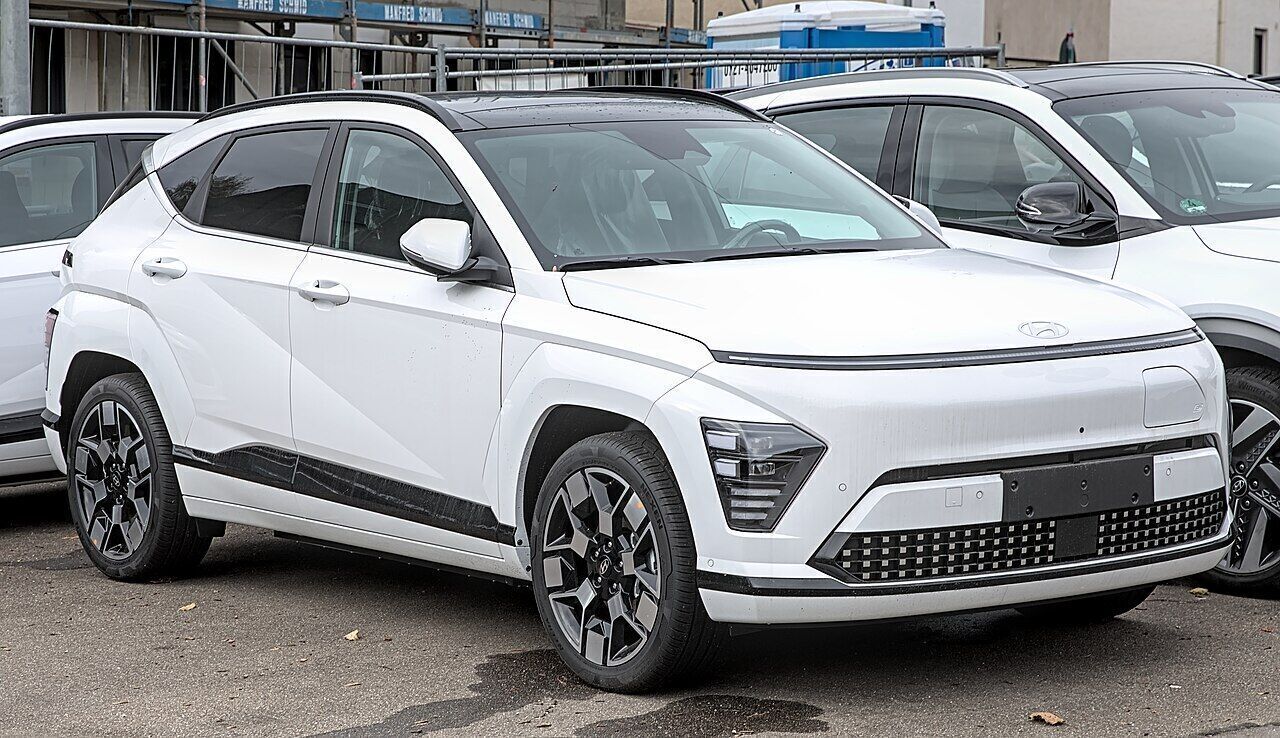
Hyundai Kona Electric (2024) specs, price, ratings and reviews
Compact electric crossover, second generation.
from € 40,995
Category scores
Specifications
- Generation
- 64 kWh (SX2, 2023+)
| Body style | Crossover |
|---|---|
| Seats | 5 |
| Doors | 5 |
| Range (WLTP, km) | 514 |
| Battery capacity (kWh — larger = longer range) | 65.4 |
| Power (hp) | 218 |
| 0–100 km/h (seconds) | 7.8 |
| Top speed (km/h) | 172 |
| Length (mm) | 4,355 |
| Width, excl. mirrors (mm) | 1,825 |
| Height (mm) | 1,575 |
| Kerb weight (kg) | 1,773 |
| Fast charging, public charger (kW, peak) | 102 |
| Towing — braked (with trailer brakes) (kg) | 750 |
| Boot (l) | 466 |
| Consumption (WLTP, kWh per 100 km — lower is better) | 16.6 |
Fast charging at a public charger (10→80%)
| Charging situation | 10→80% (minutes) |
|---|---|
| At the car's own maximum charging rate (102 kW) | ~ 43 |
| At a 150 kW charger | ~ 43 |
| At a 50 kW charger | ~ 89 |
Charging at home uses AC power and is slower: a home wallbox typically delivers 7.4 to 11 kW. That is separate from the fast-charge times shown above.
More on this: fast charging in practice, public charging and charging passes.
Real-world consumption
- Owners report
- 18.5 kWh/100km
- WLTP (manufacturer figure)
- 16.6 kWh/100km
- Difference vs WLTP
- +11%
Price evolution
| reference date | starting price |
|---|---|
| 2024-01-01 | €39,495 |
| 2025-01-01 | €40,295 |
| 2026-05-18 | €40,995 |
Frequently asked
What does the Hyundai Kona Electric cost roughly?
Indicative starting price € 40,995 (reference date 2026-05-18). Not an offer.
What is the WLTP range of the Hyundai Kona Electric?
514 km WLTP (manufacturer figure). Owners typically report less in everyday driving, especially in cold weather. See the reviews below.
How much can the Hyundai Kona Electric tow?
750 kg braked (with trailer brakes) — the figure that applies when your trailer (such as a caravan) has its own brakes. Manufacturer figure; the exact, binding limit for a specific car is on its registration document.
How long does fast-charging the Hyundai Kona Electric take (10→80%)?
Roughly 43 minutes on a 102 kW charger (10→80%, factory calculation, indicative). Actual time depends on battery temperature and the charging curve — the car's charging speed drops as the battery fills.
How big is the battery in the Hyundai Kona Electric?
65.4 kWh usable capacity (manufacturer figure). Check the warranty terms of the specific car for capacity retention.
What does the Hyundai Kona Electric use in real-world driving?
The factory WLTP figure is 16.6 kWh/100 km. Owners typically report more in mixed use, with the usual winter penalty. See the owner experiences below.
How much boot space does the Hyundai Kona Electric have?
466 litres (manufacturer figure). See the spec sheet for the full dimensions.
What the press has reported
What others wrote, condensed. Every claim stays attributed and links back to the original review, so you can read the full verdict where it was written.
What owners report elsewhere about the Kona Electric
This is a summary of public forums, not verified by us and not a first-party review. Recurring points: summer consumption around 15-17 kWh/100km, rising to 19-21 kWh/100km in freezing weather (user-reported), which brings the 514 km WLTP back toward 350-380 km in winter. The recurring criticism is the DC charging peak of around 102 kW, which makes a 10-80% charging session take longer than with some competitors. Plus points in the posts: efficiency at moderate speed, rear-seat space and the battery warranty. See the sources for the original, full posts.
sources: r/elektrischeauto: Hyundai Kona Electric ervaringen · Tweakers Gathering: Hyundai Kona Electric
Owner experiences
Frugal in the city, slow at the fast charger · 4/5
Anonymous owner · 2026-04-08 · owner experience
A daily commute of 60 km, charging at home. In spring I sit at around 15.5 kWh/100km, which is tidy. The range matches my usage: well over 450 km when driving moderately, and in January during frost I saw it heading towards 360 km. What I run into is fast charging on a long trip: above 80% it crawls, and the peak doesn't reach what I was used to with other EVs. So plan an extra stop. The interior is solid, and an adult sits fine in the back.
*Submitted via the review form and moderated (only spelling/readability adjusted, content and score unchanged).*
Show 2 more experiences
Winter use costs range, charging speed disappoints · 3/5
Anonymous owner · 2026-01-30 · owner experience
My commute is about 70 km a day, all year round, roughly 22,000 km per year. In summer I get close to 450 km on a charge; in January, with the heating on, that drops toward 340 km. For daily use that's enough, but on a long trip you notice the real downside: the DC charging peak of around 100 kW means I spend longer at the fast charger than friends with other EVs. A 10-80% session takes noticeably longer in winter because the pack first has to warm up. The heat pump helps, but it doesn't erase the difference. Plus points: the controls with physical buttons are pleasant and the seat heating is fast. The rear bench is on the cramped side for a crossover of this size.
*Submitted via the review form and moderated (only spelling/readability adjusted, content and score unchanged).*
Home charger makes it relaxed, fine family car · 5/5
Anonymous owner · 2026-03-26 · owner experience
Family with two small children, mostly city and regional driving, occasionally a trip to the coast. Around 16,000 km per year. I almost always charge at home on the wallbox, so the lower fast-charging speed barely affects me. In practice, consumption comes out around 16-17 kWh/100km in summer, and more like 19-20 in winter. The 466 l boot swallows the pram plus the groceries without any juggling. What I appreciate is the calm in the car and the clear controls, no hidden menus for the basic functions. Small downside: over speed bumps in the city the suspension feels a bit short, and the rearward visibility is mediocre without the camera. In almost two years no breakdowns, only software updates.
*Submitted via the review form and moderated (only spelling/readability adjusted, content and score unchanged).*
In depth
514 km WLTP, 65.4 kWh. The DC charging peak at 102 kW is lower than at some competitors; a 10-80% charge therefore takes relatively long (manufacturer figure). Braked towing weight 750 kg.
About the Hyundai Kona Electric (2024)
Independent spec and rating reference. No offers, no sales.
The second generation grew in size; in the back and in the boot (466 l) it is more spacious than before. The car sits on a 400V architecture. The DC charging power peaks around 102 kW, lower than 800V competitors, which makes fast charging take longer; count on a manufacturer figure of over 40 minutes for 10-80% (not measured by us).
In practice
WLTP consumption is 16.6 kWh/100km (manufacturer figure). Over a whole year, including winter trips, owners report mixed around 18.5 kWh/100km (owner forums, n≈22, not measured by us); that pushes the real range below the 514 km WLTP. The indicative list price rose from about 39,495 euro (reference date early 2024) to 40,995 euro now, a from-price, no offer and no forecast.
Points to note
Winter consumption is, according to owners, 15-25% above WLTP. The braked towing weight of 750 kg is limited for those who want to tow. The relatively low charging peak makes the car less suitable for those who often drive long motorway trips with several charging stops; check the charging curve against your fixed route.
Related models
No tax or financial advice. Every figure shows its source and reference date. Always compare with an independent adviser and the official source. Source: OEM datasheets + RDW + ADAC (see methodology); rating and price reference dates are listed per figure.