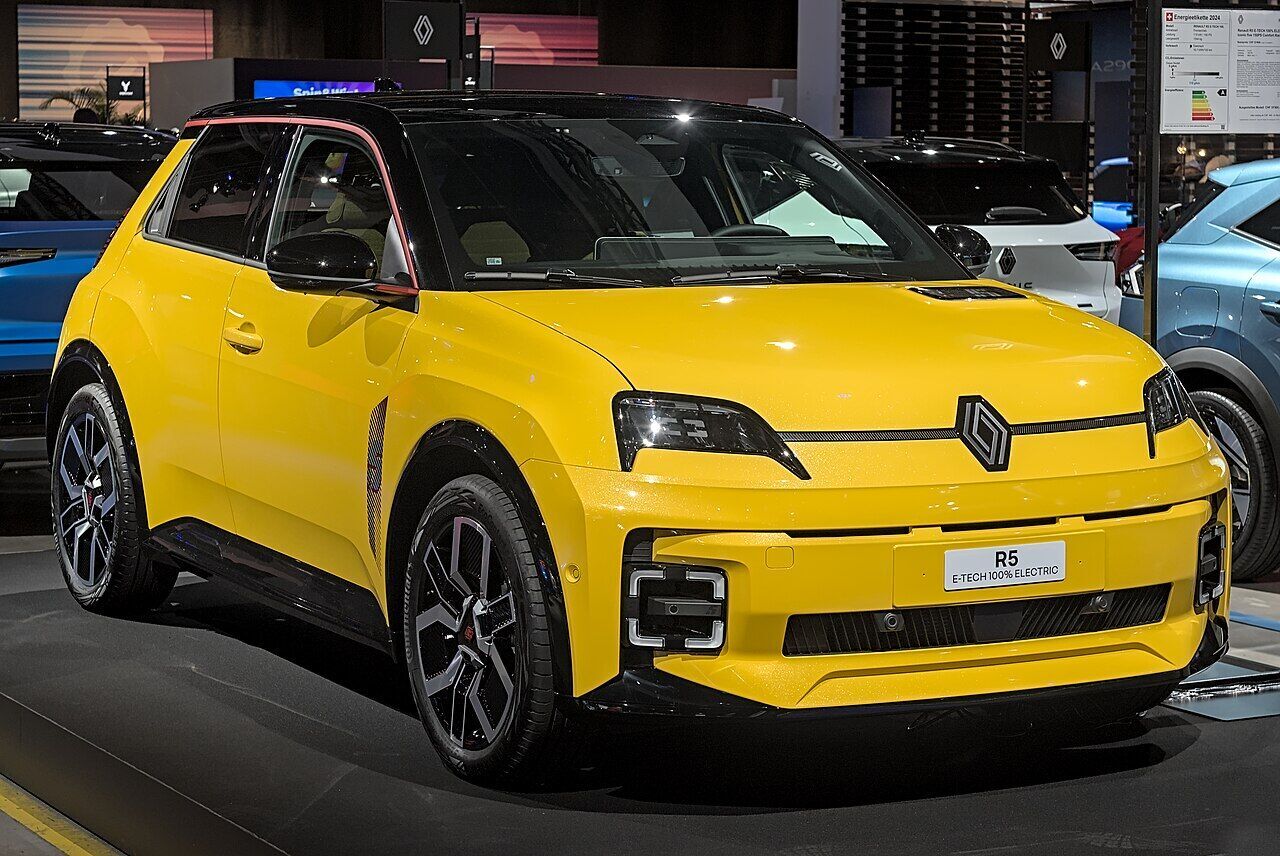
Renault 5 E-Tech (2024) specs, price, ratings and reviews
Compact city-focused EV on the AmpR-Small platform.
from € 27,900
Category scores
Specifications
- Generation
- E-Tech Electric 52 kWh (2024)
| Body style | Hatchback |
|---|---|
| Seats | 5 |
| Doors | 5 |
| Range (WLTP, km) | 410 |
| Battery capacity (kWh — larger = longer range) | 52 |
| Power (hp) | 150 |
| 0–100 km/h (seconds) | 7.9 |
| Top speed (km/h) | 150 |
| Length (mm) | 3,922 |
| Width, excl. mirrors (mm) | 1,774 |
| Height (mm) | 1,498 |
| Kerb weight (kg) | 1,460 |
| Fast charging, public charger (kW, peak) | 100 |
| Towing — braked (with trailer brakes) (kg) | 0 (not permitted) |
| Boot (l) | 326 |
| Consumption (WLTP, kWh per 100 km — lower is better) | 14.5 |
Fast charging at a public charger (10→80%)
| Charging situation | 10→80% (minutes) |
|---|---|
| At the car's own maximum charging rate (100 kW) | ~ 35 |
| At a 150 kW charger | ~ 35 |
| At a 50 kW charger | ~ 70 |
Charging at home uses AC power and is slower: a home wallbox typically delivers 7.4 to 11 kW. That is separate from the fast-charge times shown above.
More on this: fast charging in practice, public charging and charging passes.
Real-world consumption
- Owners report
- 16.5 kWh/100km
- WLTP (manufacturer figure)
- 14.5 kWh/100km
- Difference vs WLTP
- +14%
Price evolution
| reference date | starting price |
|---|---|
| 2024-06-01 | €26,900 |
| 2025-01-01 | €27,400 |
| 2026-05-18 | €27,900 |
Frequently asked
What does the Renault 5 E-Tech cost roughly?
Indicative starting price € 27,900 (reference date 2026-05-18). Not an offer.
What is the WLTP range of the Renault 5 E-Tech?
410 km WLTP (manufacturer figure). Owners typically report less in everyday driving, especially in cold weather. See the reviews below.
How long does fast-charging the Renault 5 E-Tech take (10→80%)?
Roughly 35 minutes on a 100 kW charger (10→80%, factory calculation, indicative). Actual time depends on battery temperature and the charging curve — the car's charging speed drops as the battery fills.
How big is the battery in the Renault 5 E-Tech?
52 kWh usable capacity (manufacturer figure). Check the warranty terms of the specific car for capacity retention.
What does the Renault 5 E-Tech use in real-world driving?
The factory WLTP figure is 14.5 kWh/100 km. Owners typically report more in mixed use, with the usual winter penalty. See the owner experiences below.
How much boot space does the Renault 5 E-Tech have?
326 litres (manufacturer figure). See the spec sheet for the full dimensions.
What the press has reported
What others wrote, condensed. Every claim stays attributed and links back to the original review, so you can read the full verdict where it was written.
What owners report elsewhere about the 5 E-Tech
This is a summary of early public forums, not verified by us and not a first-party review. The sample is small because the model only came onto the market in 2024. Recurring points: city consumption around 13-15 kWh/100km (user-reported), rising on the motorway and in the cold. The 410 km WLTP figure is experienced by owners as around 300-340 km in mixed use. Positives in the posts: agility, styling and the price for an EV with this range; criticism concerns the stiff rear bench and limited boot space. See the sources for the original, complete posts.
sources: r/elektrischeauto: Renault 5 E-Tech ervaringen · Tweakers Gathering: Renault 5 E-Tech Electric
Owner experiences
Fun city car, the boot is cramped · 4/5
Anonymous owner · 2026-04-19 · owner experience
My daily car since the start of this year, mostly city and regional driving. Consumption in the city is around 14 kWh/100km; on the motorway at 120 km/h it climbs to 18 and the range drops noticeably. For my trips I comfortably get 300-330 km. It steers nicely, the turning circle is small, and parking is done in no time. Downside: the boot is really on the small side and the rear bench is firm on longer trips. For anyone using it as a city and regional car the picture adds up; for long holiday trips I wouldn't want it as my only car.
*Submitted via the review form and moderated (only spelling/readability adjusted, content and score unchanged).*
Show 2 more experiences
City car that gives up range in winter · 4/5
Anonymous owner · 2026-01-26 · owner experience
Mainly city use and short trips in the region, around 13,000 km per year. In the city this is a pleasant car: compact, agile, good visibility and the regeneration via the shifter often lets you drive with one pedal. Consumption in summer around 13-14 kWh/100km, in January with the heating on closer to 17-18 and the range then drops from the WLTP 410 km to about 280-300 in practice. More than enough for city use, but anyone who also wants to do long winter trips with it should keep that in mind. The rear seat and the 326 l boot are small; with two children plus groceries it becomes a puzzle. The controls are clear and the screen responds quickly. No faults in the first year.
*Submitted via the review form and moderated (only spelling/readability adjusted, content and score unchanged).*
Fun to drive, long trips aren't its thing · 3/5
Anonymous owner · 2026-03-18 · owner experience
Bought as the only car in the household, so also for the occasional long trip, around 17,000 km per year. In daily use there's little to fault: it steers nimbly, the seating is good and consumption stays around 14-15 kWh/100km in mixed driving. The bottleneck is the long trip. On the motorway at 120 km/h consumption climbs toward 18-19 kWh/100km and the range drops noticeably, so I have to charge more often than I'd like. DC charging up to around 100 kW is fine for the class but still makes the stops frequent on a long route. For the city and the region a nice car, for those who regularly drive 300+ km in one go less suitable. The finish is tidy and the retro interior is pleasing. No technical problems so far.
*Submitted via the review form and moderated (only spelling/readability adjusted, content and score unchanged).*
In depth
WLTP around 410 km with the 52 kWh pack (manufacturer figure indicative); in winter comparable EVs report 20-30% less among owners (public forums not measured by us). DC charging up to about 100 kW.
About the Renault 5 E-Tech (2024)
Independent spec and rating reference. No offers, no sales.
A compact EV aimed at city and regional use. With the 52 kWh pack Renault states around 410 km WLTP (manufacturer figure, indicative). For practice reckon with a margin: with comparable EVs owners report 20-30% less than WLTP in winter at motorway speed (public forums, not measured by us); early owner forums point to mixed use around 16.5 kWh/100km, but the sample is still small (n≈8). DC charging goes up to about 100 kW; 10-80% takes around 30 minutes under favourable conditions (manufacturer figure). The indicative list price rose from about 26,900 euros (reference date mid 2024) to 27,900 euros now, a starting price, no offer and no forecast. Reliability and residual value rest on insufficient data: the model has been on the market since 2024 and does not yet have a full cycle of breakdown or residual-value figures.
Points to note
The towing weight is zero. The boot is tight at 326 l for anyone who carries a lot. In the rear the space is city-car-typically limited. Check whether the stated range after the winter margin still suffices for your longest regular trip, the method is in the guide on WLTP versus practice.
Related models
No tax or financial advice. Every figure shows its source and reference date. Always compare with an independent adviser and the official source. Source: OEM datasheets + RDW + ADAC (see methodology); rating and price reference dates are listed per figure.