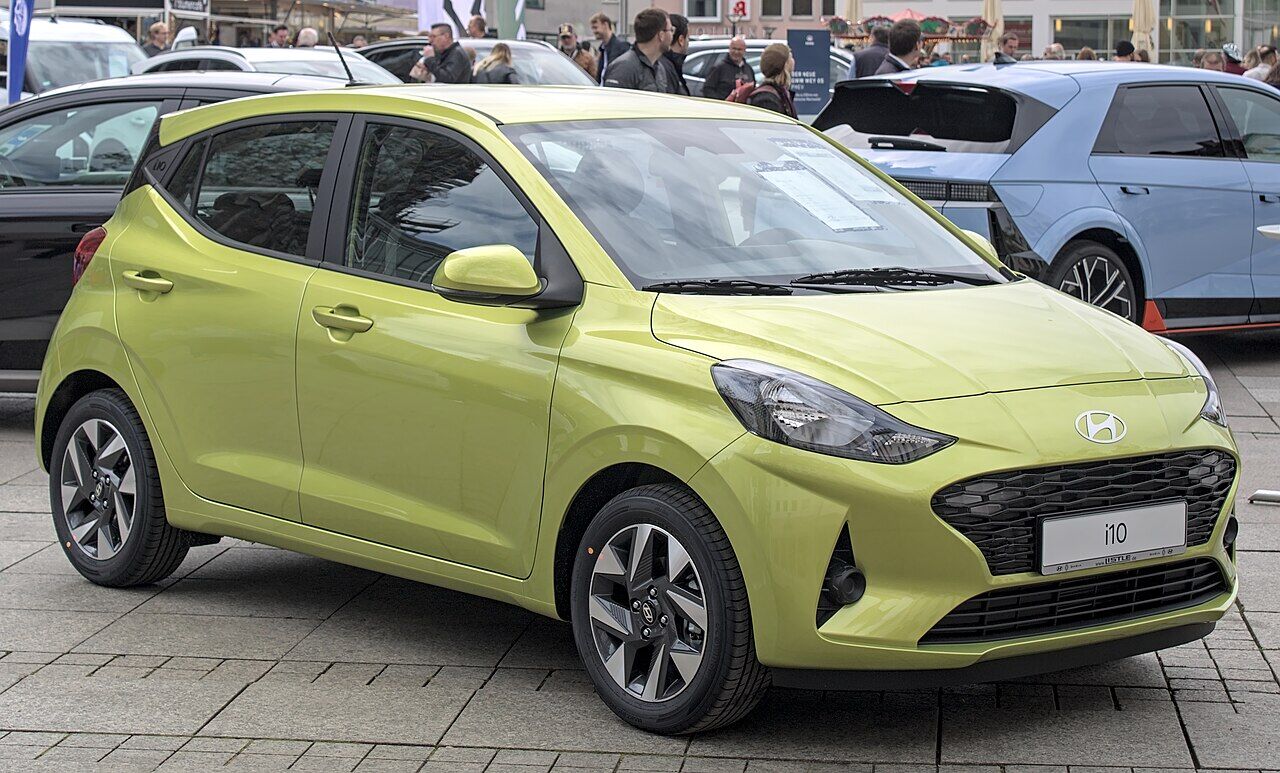
Hyundai i10 (2024) specs, price, ratings and reviews
A-segment city car with petrol engine, facelift of the third generation.
from € 18,495
Category scores
Specifications
- Generation
- AC3, facelift (2024)
| Body style | Hatchback |
|---|---|
| Seats | 5 |
| Doors | 5 |
| Power (hp) | 67 |
| 0–100 km/h (seconds) | 14.8 |
| Top speed (km/h) | 156 |
| Length (mm) | 3,670 |
| Width, excl. mirrors (mm) | 1,680 |
| Height (mm) | 1,480 |
| Kerb weight (kg) | 921 |
| Towing — braked (with trailer brakes) (kg) | 0 (not permitted) |
| Boot (l) | 252 |
| Consumption (WLTP, l per 100 km) | 5.4 |
Price evolution
| reference date | starting price |
|---|---|
| 2024-01-01 | €17,495 |
| 2025-01-01 | €17,995 |
| 2026-05-18 | €18,495 |
Frequently asked
What does the Hyundai i10 cost roughly?
Indicative starting price € 18,495 (reference date 2026-05-18). Not an offer.
What does the Hyundai i10 consume?
5.4 l/100km WLTP (manufacturer figure). Real-world consumption differs; see the owner reviews below.
How much boot space does the Hyundai i10 have?
252 litres (manufacturer figure). See the spec sheet for the full dimensions.
Owner experiences
No owner has written in about this one yet. If you drive it, yours would be the first. Write the first owner review.
In depth
The entry version has a 1.0 three-cylinder around 67 hp; WLTP consumption is around 5.4 l/100km (manufacturer figure, not measured by us). Boot 252 l, five seats. Not officially permitted to tow. Indicative from-price; check the official configurator for the current figure.
About the Hyundai i10 (2024)
Independent spec and rating reference. No offers, no sales.
The i10 is an A-segment city car on a conventional 400V-less petrol drivetrain. The 2024 facelift brought a changed grille and new wheel and colour options. The entry engine is a 1.0 three-cylinder around 67 hp; there is also a stronger 1.2. WLTP consumption stands at about 5.4 l/100km for the base engine (manufacturer figure, not measured by us).
In practice
The boot is 252 l, cramped but usable for daily city use. The car has five seats, although the rear bench is mainly suited to shorter trips. Owners report real-world consumption in mixed use that is 0.3 to 0.8 l above WLTP, depending on the motorway share (public forums, not measured by us). The indicative list price rose from about 17,495 euro (reference date early 2024) to 18,495 euro now, a from-price, no offer and no forecast.
Points to note
The i10 is not permitted for towing a trailer; count on 0 kg braked towing weight. On the motorway the small engine works hard, which drives up consumption and the noise level. For those who mainly drive city and region, that is less relevant; compare the consumption profile against your fixed route.
Related models
No tax or financial advice. Every figure shows its source and reference date. Always compare with an independent adviser and the official source. Source: OEM datasheets + RDW + ADAC (see methodology); rating and price reference dates are listed per figure.