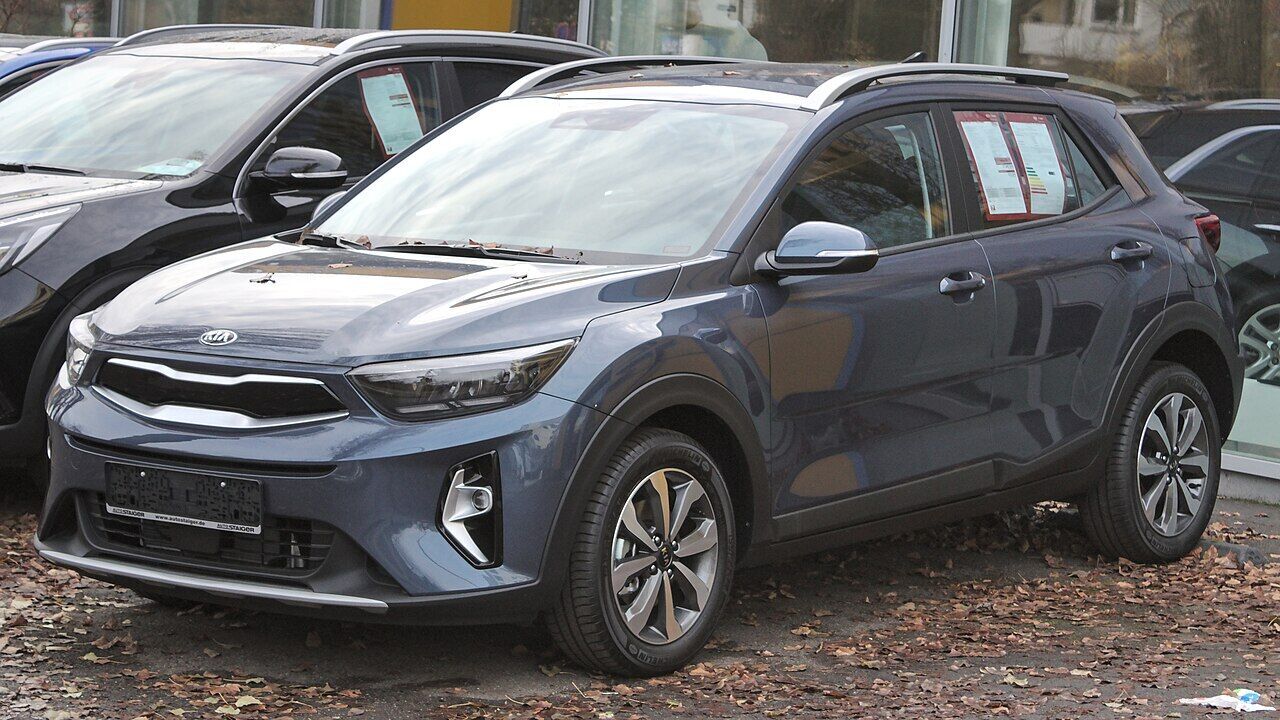
Kia Stonic (2024) specs, price, ratings and reviews
Compact crossover on the Rio platform with petrol engine, second facelift.
from € 23,995
Category scores
Specifications
- Generation
- YB, tweede facelift (2024)
| Body style | Crossover |
|---|---|
| Seats | 5 |
| Doors | 5 |
| Power (hp) | 100 |
| Length (mm) | 4,165 |
| Width, excl. mirrors (mm) | 1,760 |
| Height (mm) | 1,485 |
| Kerb weight (kg) | 1,225 |
| Towing — braked (with trailer brakes) (kg) | 1,110 |
| Boot (l) | 352 |
| Consumption (WLTP, l per 100 km) | 5.7 |
Price evolution
| reference date | starting price |
|---|---|
| 2024-01-01 | €22,995 |
| 2025-01-01 | €23,495 |
| 2026-05-18 | €23,995 |
Frequently asked
What does the Kia Stonic cost roughly?
Indicative starting price € 23,995 (reference date 2026-05-18). Not an offer.
What does the Kia Stonic consume?
5.7 l/100km WLTP (manufacturer figure). Real-world consumption differs; see the owner reviews below.
How much can the Kia Stonic tow?
1110 kg braked (with trailer brakes) — the figure that applies when your trailer (such as a caravan) has its own brakes. Manufacturer figure; the exact, binding limit for a specific car is on its registration document.
How much boot space does the Kia Stonic have?
352 litres (manufacturer figure). See the spec sheet for the full dimensions.
Owner experiences
No owner has written in about this one yet. If you drive it, yours would be the first. Write the first owner review.
In depth
The common version has a 1.0 T-GDI three-cylinder with mild-hybrid support around 100 hp; WLTP consumption around 5.7 l/100km (manufacturer figure, not measured by us). Boot 352 l, five seats. Indicative from-price; check the official configurator for the current figure.
About the Kia Stonic (2024)
Independent spec and rating reference. No offers, no sales.
The Stonic is a compact B-segment crossover, closely related to the Hyundai Bayon and built on the same platform as the Rio. It competes with the Renault Captur, Opel Mokka and Ford Puma. The recent second facelift brought a revised front, new bumpers and an updated infotainment. The common engine is a 1.0 T-GDI three-cylinder with 48V mild-hybrid support around 100 hp. WLTP consumption stands at about 5.7 l/100km (manufacturer figure, not measured by us).
In practice
The boot is 352 l, smaller than the Bayon despite the close family relationship, because of a different rear floor layout. The car has five seats; the rear bench is suited to two adults on a normal trip. Owners report real-world consumption in mixed use that is 0.5 to 1.1 l above WLTP, depending on the motorway share (public forums, not measured by us). The indicative list price rose from about 22,995 euro (reference date early 2024) to 23,995 euro now, a from-price, no offer and no forecast.
Points to note
The Stonic is front-wheel drive only. The braked towing weight of 1,110 kg is modest, the same as on the Bayon. Kia's 7-year warranty weighs in the reliability score. Compare the Bayon directly: it has a larger boot, the Stonic has often slightly sharper pricing.
Related models
No tax or financial advice. Every figure shows its source and reference date. Always compare with an independent adviser and the official source. Source: OEM datasheets + RDW + ADAC (see methodology); rating and price reference dates are listed per figure.