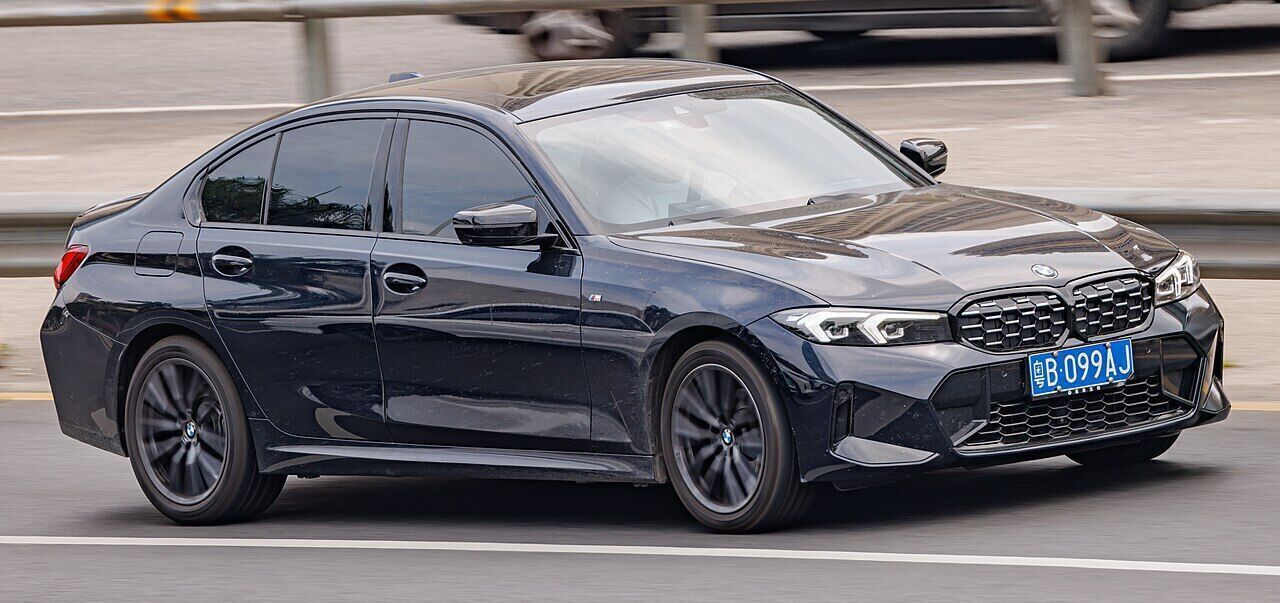
BMW 3-serie (2024) specs, price, ratings and reviews
Rear-wheel drive D-segment sedan with the 2.0 four-cylinder turbodiesel plus 48V mild hybrid.
from € 52,900
Category scores
Specifications
- Generation
- 320d (G20, LCI facelift 2022)
| Body style | Sedan |
|---|---|
| Seats | 5 |
| Doors | 5 |
| Power (hp) | 190 |
| 0–100 km/h (seconds) | 6.9 |
| Top speed (km/h) | 235 |
| Length (mm) | 4,713 |
| Width, excl. mirrors (mm) | 1,827 |
| Height (mm) | 1,440 |
| Kerb weight (kg) | 1,645 |
| Diesel consumption (l per 100 km) | 4.8 |
| Towing — braked (with trailer brakes) (kg) | 1,800 |
| Boot (l) | 480 |
Real-world consumption
- Owners report
- 5.3 l/100km
Price evolution
| reference date | starting price |
|---|---|
| 2024-01-01 | €49,500 |
| 2025-01-01 | €51,200 |
| 2026-05-18 | €52,900 |
Frequently asked
What does the BMW 3-serie cost roughly?
Indicative starting price € 52,900 (reference date 2026-05-18). Not an offer.
How much can the BMW 3-serie tow?
1800 kg braked (with trailer brakes) — the figure that applies when your trailer (such as a caravan) has its own brakes. Manufacturer figure; the exact, binding limit for a specific car is on its registration document.
How much boot space does the BMW 3-serie have?
480 litres (manufacturer figure). See the spec sheet for the full dimensions.
What the press has reported
What others wrote, condensed. Every claim stays attributed and links back to the original review, so you can read the full verdict where it was written.
What owners report elsewhere about the 3 Series
This is a summary of public forums, not verified by us and not a first-party review. Recurring points in the posts: motorway fuel consumption that stays around 4.8-5.2 l/100km when driving calmly, rising towards 6 l/100km at high speed (owner figures). The rear-wheel steering and the chassis are often cited as strong points; complaints concern the cost of service intervals and occasional EGR/AdBlue warnings at higher mileages. A towing weight of 1,800 kg is described as more than sufficient for caravan use. See the sources for the original, complete posts.
sources: MotorTalk: BMW 3er G20 Dieselforum · Spritmonitor: BMW 320d verbruiksdata
Owner experiences
Long-distance diesel that delivers on its brief · 4/5
Anonymous owner · 2026-03-22 · owner experience
I drive around 45,000 km per year for work, mostly on the motorway. At 120 km/h with cruise control I sit around 5.1 l/100km on the onboard computer, in winter slightly above 5.5. Comfort on long trips is its strong point; the seats are still fine after three hours. The downside: the dealer service turned out more expensive than I was used to, and the AdBlue warning came earlier than the onboard computer's forecast indicated. I occasionally tow a trailer of around 1,200 kg, and it does that without any trouble.
*Submitted via the review form and moderated (only spelling/readability adjusted, content and score unchanged).*
Show 2 more experiences
Frugal on the motorway, short trips are a different story · 4/5
Anonymous owner · 2026-02-14 · owner experience
Driven for business, almost exclusively motorway, around 45,000 km per year. On cruise control at 120-130 km/h I sit between 4.9 and 5.4 l/100km, roughly what the factory figure promises. The difference shows up in winter and on short trips: a Wednesday with only city runs went towards 7 and the DPF regeneration came by noticeably more often. The mild hybrid handles coasting nicely, you notice it especially in traffic jams. The seats and sound insulation are the strong point after a long day. The weaker side: the adaptive damping feels more restless on bad asphalt than I had expected for this price class, and setting the wiper interval via the screen remains cumbersome.
*Submitted via the review form and moderated (only spelling/readability adjusted, content and score unchanged).*
Tows the caravan effortlessly, cramped rear seats · 3/5
Anonymous owner · 2026-04-19 · owner experience
Bought it to tow a caravan of around 1,500 kg, holiday driving plus weekend use, roughly 18,000 km per year. With the caravan behind it the consumption rises to 9-10 l/100km, solo on the motorway around 5.2. The low-end torque makes towing relaxed, even on inclines in Germany there's no hunting for power. What disappoints for a family car: with two teenage children in the back, legroom is tight and the centre tunnel is high. The 480 l boot swallows a lot, but the loading lip is high. In the first year there was one software recall for the onboard electronics, otherwise no faults. Solid but not the space marvel I had hoped for.
*Submitted via the review form and moderated (only spelling/readability adjusted, content and score unchanged).*
In depth
WLTP around 4.8 l/100km (manufacturer figure, indicative); on long distance owners report 5-5.5 l/100km (public forums, not measured by us). Braked towing weight 1,800 kg.
About the BMW 320d (G20, 2024)
Independent spec and rating reference. No offers, no sales.
The 320d remains the long-distance choice within the G20. The car is rear-wheel drive, an 8-speed automatic is standard in most markets. The 2022 LCI facelift revised the front, the infotainment (iDrive 8) and some material choices; the drivetrain stayed the same at the base.
In practice
WLTP figure is about 4.8 l/100km (manufacturer figure, not measured by us). On the motorway owners report 5-5.5 l/100km, long-distance average around 5.3 (owner forums, n≈25, not measured by us). The 1,800 kg braked towing weight is high for the class. The indicative list price rose from about 49,500 euro (reference date early 2024) to 52,900 euro now; this is a starting price, not an offer and not a forecast.
Points to note
Diesel is under increasing environmental-zone restrictions in several EU cities; check the rules for your regular routes. The AdBlue refill interval and the particulate-filter regeneration require sufficiently long trips, short-trip use is less suitable for this drivetrain. With predominantly city use an incomplete particulate-filter regeneration can lead to follow-up costs. The iDrive 8 controls shift many functions to the screen; whether that works pleasantly is a matter of taste, check it on a test drive at the official dealer. The driving behaviour is rear-wheel drive and neutral at the base; the drivetrain is aimed at long distance, not economical city traffic.
Related models
No tax or financial advice. Every figure shows its source and reference date. Always compare with an independent adviser and the official source. Source: OEM datasheets + RDW + ADAC (see methodology); rating and price reference dates are listed per figure.